The 2020 Nilbog Draft will start on Friday, May 8th, at 6:00 P.M. EST, in Sleeper. You can participate on your phone through the app, or on Sleeper’s website. Each G.M. will have 10 minutes to make their selection. After round one ends, the draft will be paused until the next day. The draft will resume with round two on Saturday, May 9th, at 2:00 P.M. EST. When the second round is finished, the draft will be paused once again. The third and final round will start on Sunday, May 10th, at 2:00 P.M. EST. If you do not make your selection in the time allotted, the Sleeper CPU will auto-pick for you. There will be a Discord setup to allow discussion and trade offers during the draft.
Now that those details are out of the way, let’s get into actually analyzing these rookies. Below, I’ll list the top 16 rookies by their average draft position (ADP). I’m determining ADP based on a composite of Sleeper’s rankings, aggregate expert rankings, as well as trends since the NFL draft. Below each player, I’ll write a little bit about them so you can have an idea of who you may be interested in selecting. Come back for issue 2 tomorrow, which will go over rookies 17 – 32.
It is worth noting before starting that this is considered a historically talented rookie class. It includes two incredibly elite running back prospects with several more who could go 1.01 in other years; and two of the best receiver prospects this decade rounded out by an incredibly deep run of talented WRs. Plus, there’s a some excellent quarterbacks who already have starting jobs locked up. The only drawback is that this class is considered weaker at tight end than what’s to come in 2021/2022.
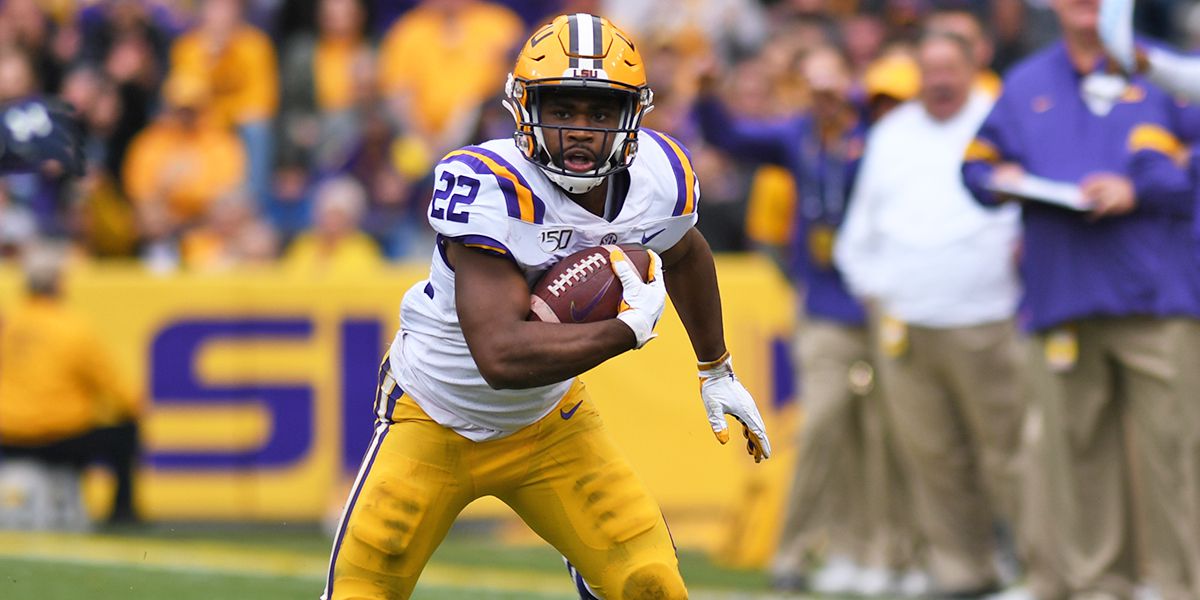
#1. Clyde Edwards-Helaire (LSU), RB[1] – KC Chiefs
CEH was the first running back taken in the NFL draft, by Kansas City at the end of the first round. He’s being most compared to Brian Westbrook, who had an incredible career with K.C. coach Andy Reid in the mid 2000’s. However, Edwards-Helaire will have to compete with Damien Williams for carries his first year. Before the NFL draft, CEH was going sixth overall (RB #4) in mock dynasty drafts.
#2A. Jonathan Taylor (Wisconsin), RB[2A] – Indianapolis Colts
Jonathan Taylor was the third running back taken in the NFL draft, by the Indianapolis Colts in the early second round. Taylor is considered an incredible RB prospect who combines a solid size (5’11/221 lbs) with elite quickness (4.39 40), and was going first overall in mock dynasty drafts before the NFL draft. However, J.T. will be part of a very crowded Indianapolis backfield his first year, that include Marlon Mack, Jordan Wilkins, and Nyheim Hines.
#2B. D’Andre Swift (Georgia), RB[2B] – Detroit Lions
D’Andre Swift was the second running back taken in the NFL draft, by the Detroit Lions at the start of the second round. Swift is considered as another elite prospect, a three down back with excellent pass catching ability. But Detroit still has two years left on Kerryon Johnson’s rookie contract, so he may be used in a committee for the foreseeable future.
#4A. CeeDee Lamb (Oklahoma), WR[1A] – Dallas Cowboys
CeeDee Lamb was the third wide receiver taken in the NFL draft, by the Dallas Cowboys in the mid first. Lamb is an ankle breaker, an absolute playmaker. If he gets the ball with any space, he makes shit happen. Oh, and he’s not just some elusive juker – he’s a 6’1″ upright runner who is tough to bring down. He struggles to get open on downfield plays and make contested catches, but most receivers do coming out of college. Not to mention, Dallas didn’t choose him to be a burner – that’s what Michael Gallup is for. Lamb will likely be used in frequent three receiver sets, and work a role similar to Amari Cooper – although as a clear #2 to begin. I’ve seen Lamb frequently compared to DeAndre Hopkins, and that should really be enough said.
#4B. Jerry Jeudy (Alabama), WR[1B] – Denver Broncos
Jerry Jeudy was the second wide receiver taken in the NFL draft, by the Denver Broncos in the mid first. Jeudy may be the best route runner coming out of college in at least the last five years. His size and 40 time is almost identical to Lamb, but you wouldn’t know it by watching him. Unlike Lamb, Jeudy consistently excels at getting open deep and roasting secondaries. But he’s not just a burner. Jeudy embraces contact and makes plays in traffic during underneath routes. His situation in Denver could be better, but it could also be a lot worse. At receiver, he’ll work alongside Courtland Sutton and fellow rookie K.J. Hammler; with unproven but promising sophomore quarterback Drew Lock throwing him the ball. Jeudy has been compared to A.J. Green.
#6. J. K. Dobbins (Ohio state), RB[4] – Baltimore Ravens
J. K. Dobbins was the fifth running back taken in the NFL draft, by the Baltimore Ravens in the mid second round. He’s an excellent prospect who is capable of bellcow carries. Interestingly, I’ve seen him compared to Mark Ingram, who he’ll share a backfield with in 2020. Ingram was excellent in Baltimore last year (RB #8), so Dobbins should have a lot of opportunity to shine once the Ravens are ready to cut back Ingram’s carries.
#7. Cam Akers (Florida state), RB[5] – Los Angeles rams
Cam Akers was the fourth running back taken in the NFL draft, by the Los Angeles Rams in the mid second round. Akers succeeded at Florida State despite an abysmal offensive line, and is considered a athletic and powerful runner with a physical style of running. On the Rams – who cut Todd Gurley this off season – he has a chance to dominate in Sean McVay’s offense. However, it’s unsure whether Akers will get the chance to start over both Malcom Brown and last year’s third round pick, Darrell Henderson (AKA Darnell Anderson). If he does start, he’ll easily be a RB1.
#8. Henry Ruggs III (Alabama), WR[3] – Las Vegas Raiders
At the NFL combine, Henry Ruggs III ran a 4.27 40 yard dash, the fourth fastest since electronic timing had been introduced. Some say it was at that moment the ghost of Al Davis appeared and told Mike Mayock that Ruggs had to be a Raider. Ruggs was the first receiver selected in the NFL draft, by the Los Angeles Raiders in the mid first round. Ruggs has a smaller frame, but boasts incredible route speed and play making ability with the ball in his hand. He may not be as complete as fellow Alabama receiver Jerry Jeudy, but Ruggs should make an excellent NFL receiver. In fact, the primary criticism of Ruggs is that he’ll be a better NFL receiver than consistent fantasy producer, and he was going much later in dynasty mocks before the NFL draft – often falling to the #12 – #18 range. However, his presumed role as the #1 in Vegas has lead to a considerable rise in many expert rankings.
#9. Jalen Reagor (Alabama), WR[4] – Philadelphia eagles
Jalen Reagor was the fourth wide receiver taken in the NFL draft, by the Philadelphia Eagles in the mid second round. Reagor is a dynamic prospect who excels most at downfield attacking. He joins an Eagles receiving corps with a lot of competent talent, but nobody especially exciting. Reagor will have the opportunity to establish himself as Carson Wentz’s new #1, but there’s always the chance he goes the way of J.J. Arcega-Whiteside.
#10. Justin Jefferson (LSU), WR[5] – Minnesota Vikings
Justin Jefferson was the fifth wide receiver taken in the NFL draft, by the Minnesota Vikings in the mid second round. Jefferson is a quality route runner and catcher whose biggest criticism is that he lacks the speed to burn NFL defenses. Jefferson will likely be used as the #2 receiver and as a red zone weapon in Minnesota now that Stefon Diggs has departed.
#11. Ke’Shawn vaughn (Vanderbilt), RB[6] – Tampa Bay Buccaneers
Ke’Shawn Vaughn was the eighth running back taken in the NFL draft, by the Tampa Bay Bucs in the mid third round. Vaughn has good vision and all around talent, but with what has been projected as a low ceiling. Before the draft, he was pegged by most scouting sites as a competent NFL backup with no particular play making ability. His high fantasy value comes from the thin competition in Tampa. If Vaughnportunity can beat out Ronald Jones (who has been inconsistent the past two years) for the starting role, he has the chance to be the bellcow back for a team coached by Bruce Arians, on an offense led by Tom Brady.
#12. Denzel Mims (Baylor), WR[6] – New York Jets
Denzel Mims was the thirteenth wide receiver taken in the NFL draft, by the New York Jets in the late third round. Mims boasts an insane catch radius with the size and athleticism expected of a starting NFL receiver. His route running needs improvement, but if Mims slots into Robby Andersons former role on the Jets he should provide quality fantasy production.
#13. Tee Higgins (Clemson), WR[7] – Cincinnati Bengals
Tee Higgins was the seventh wide receiver taken in the NFL draft, by the Cincinnati Bengals in the first pick of the second round. Higgins is a 6’4″ receiver capable of excellent ball tracking skills and contested catch ability, but struggles with press coverage and route running. He’s projected to be a red zone weapon, but it remains to be seen how much he does on the Bengals offense. The Bengals added first overall pick Joe Burrow at QB, but already have a strong WR corps that includes A.J. Green, Tyler Boyd, John Ross, and Auden Tate. It may take a year or two for Higgins to get a chance to shine.
#14. Michael Pittman Jr. (USC), WR[8] – Indianapolis Colts
Michael Pittman Jr. was the eighth wide receiver taken in the NFL draft, by the Indianapolis Colts with the second pick in the second round. Pittman is a 6’4″ possession receiver capable of bullying cornerbacks downfield, but lacks top level speed and separation. While the Colts aren’t devoid of talent at WR (T.Y. Hilton, Parris Campbell, Zach Pascal), there’s still plenty of opportunity for Pittman to quickly become the team’s second option with new QB Phillip Rivers under center.
#15. bRANDON aIYUK (Arizona State), wr[9] – san francisco 49ers
Brandon Aiyuk was the sixth wide receiver taken in the NFL draft, by the San Francisco 49ers towards the back of the first round. Aiyuk is a natural pass catcher who excels at creating yards after a catch. He could use polish on route running and contested catches, but he has been steadily improving throughout his college career. Aiyuk joins a group of receivers without much going for them except Deebo Samuel, so there should be plenty of chances for him to get targets if he can prove himself.
#16. Laviska Shenault (Colorado), WR[10] – Jacksonville Jaguars
Laviska Shenault was the ninth wide receiver taken in the NFL draft, by the Jacksonville Jaguars toward the middle of the second round. Shenault offers explosive play making ability with a large, phone booth bully frame. Evaluators worry he’s too physical for his own good, and risks a short shelf life unless he improves and learns to use his route running. As a talent, he’s considered low floor but high ceiling. He moves into a Jaguars receiving corps with talent – Keelan Cole, Dede Westbrook, and D.J. Chark, so opportunity isn’t a given. Not to mention, he’ll be in a questionable quarterback situation, on an offense which moves through a running back who may hold out. Not a bad situation, but far from ideal.
 Nilbog Fantasy League