This issue will continue our look at the top incoming rookies, by aggregate expert ranking. Today, we’ll look at the rookies ranked 17 through 32 – projected second rounders.
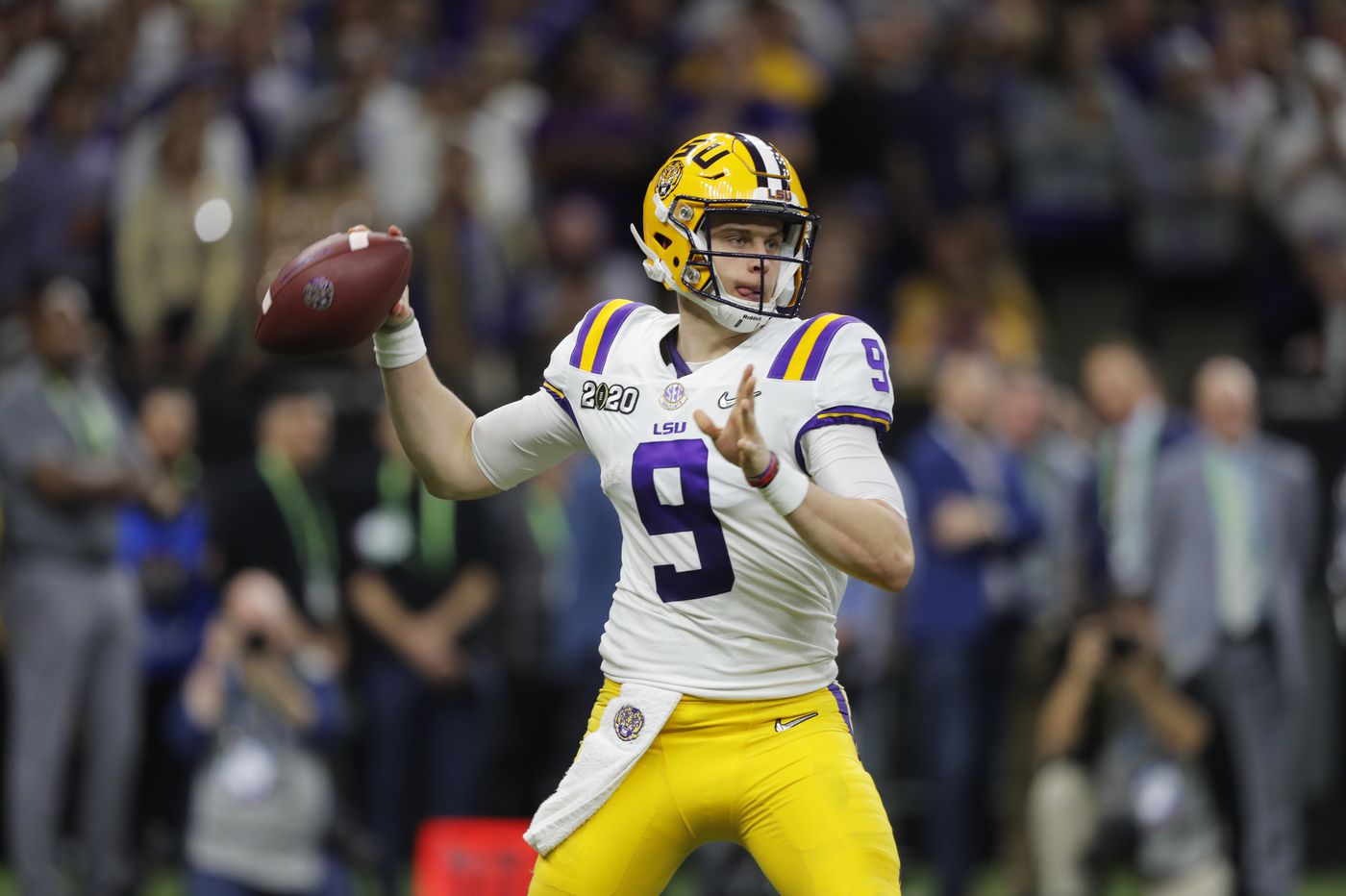
#17 – Joe Burrow (LSU), QB[1] – Cincinnati bengals
Joe Burrow was selected with the first overall pick of the NFL draft by the Cincinnati Bengals. In 2019, Burrow won the Heisman Trophy by the largest margin since O.J. Simpson in 1968. Burrow can do it all. Off the charts football I.Q., the ability to consistently fool safeties with his eyes, excellent accuracy, and a brazen field presence that energizes his team. To make matters even better, he gets an amazing situation in Cincinnati. He’s the clear day one starter – the Bengals straight up released Andy Dalton – on a team with one of the best receiving groups in the NFL.
#18 – Zack Moss (utah) , rb[7] – Buffalo Bills
Zack Moss was the ninth running back selected in the NFL draft, by the Buffalo Bills in the mid third round. Moss is a powerful bruiser and well rounded runner, but some NFL scouts say there is wear and tear that could limit the length of his career. His situation in Buffalo is interesting. Buffalo drafted Devin Singletary last year, and he shined when given carries. With the Bills losing Frank Gore this year, it was expected they were putting all their faith into Singletary. Moss may have been picked as a power runner to give breaks to Singletary and pick up tough yards. But if Moss starts outperforming his competition, he’s got the potential to be a top 16 running back.
#19 – Tua Tagovailoa (Alabama), qb[2] – Miami Dolphins
Tua Tagovailoa was the second quarterback selected in the NFL draft, by the Miami Dolphins with the fifth overall pick. Tagovailoa is a talented dual threat QB with a 8:1 touchdown – interception ratio. He’s got arm talent, good eyes, and active feet. Before a hip dislocation cost him the last part of the 2019 season, and Joe Burrow had an unexpectedly elite season, Tagovailoa was projected as a first overall pick in the NFL draft. In Miami, he’ll be a day 1 starter on an offense with a competent but unexciting group of receivers.
#20 – Bryan Edwards (South Carolina), wr[11] – Las Vegas Raiders
Bryan Edwards was the fifteenth receiver selected in the NFL draft, by the Las Vegas Raiders in the middle of the third round. Edwards combines size and play strength with good ball tracking and quick hands. However, he’s struggled with drops and route running in his college career. Although the Raiders are in need of a premier WR, it’s likely that title will go to their first round pick Henry Ruggs. Still, there’s a path to fantasy production for Edwards if Ruggs is used primarily to open up underneath routes, which Edwards excels at. Overall, Edwards seems poised for a career as a competent second/third receiving option in the NFL.
#21 – Antonio Gibson (Memphis), RB[8] – Washington Redskins
Antonio Gibson was the seventh running back selected in the NFL draft, by the Washington Redskins at the beginning of the third round. Gibson played slot receiver more often than running back in college, but has a very small sample size of touches to try and create a scouting profile from. He was essentially a one year wonder at college, managing an insane 18.2% touchdown rate on touches. There are two ways to view Gibson – he’s a big athlete (6’1″, 220 lbs.) with unparalleled versatility, which will lead to plenty of touchdown and playmaking opportunities. Or, his scouting profile is vague and unfocused, and his jack-of-all trades athletic reliance won’t translate well when he performs against NFL defenses. It will be a couple years before we know which interpretation of Antonio Gibson is the correct one.
In “D.C.”, he joins a crowded but mediocre backfield that includes Adrian Peterson, Derrius Guice, Bryce Love, and Peyton Barber. Barber had an uneventful four year stint in Tampa, and was signed in March, before Washington drafted Gibson. Plus he’s dyslexic, which means he sees the defenses backwards – so how much competition can he really be? Love was a runner up for the Heisman trophy in 2017 after a 2,000 yard season at Stanford, but hasn’t had a chance to play in the NFL yet due to an injury he suffered in his final college game in 2019. Guice has also struggled with injury, not playing at in his 2018 rookie year after tearing his ACL in a preseason game, and only playing five games in 2019 due to a torn meniscus. Still, Guice remains hyped, and has been productive in the few games he’s played. Adrian Peterson has been surprisingly good as the primary back for the Redskins the past two years, but Washington is clearly looking for someone young to take his place. In summation, there’s a path to starting running back for Gibson, but he risks falling to fourth in line behind the rest of the Redskins’ mediocre backfield.
#22 – A. J. Dillon (Boston College), RB[9] – Green Bay Packers
A.J. Dillon was the sixth running back selected in the NFL draft, by the Green Bay Packers, at the end of the second round. The Packers shocked for the second round in a row by choosing a running back so high when they already have Aaron Jones and Jamaal Williams. Dillon is built like a minibus – 6’0″, 247 lbs, but possesses enough vision and finesse to avoid being pigeon-holed as just a pure power back. In the NFL, he may need to become lighter to increase his quickness against hard nosed defenses, and his physical style of play could lead to a short career. Considering his second round draft stock, he’s expected to take the role as Green Bay’s #1 once Aaron Jones’ contract expires in 2021.
#23 – Anthony McFarland Jr. (Maryland), RB[10] – Pittsburgh Steelers
Anthony McFarland Jr. was the thirteenth running back selected in the NFL draft, by the Pittsburgh Steelers in the middle of the fourth round. McFarland is a hard runner who isn’t that big (5’8″, 208lbs) and isn’t that creative. He was projected as a sixth round pick, but got taken in the fourth, so the Steelers must have liked him. Although he has low end backup written all over him, he could have a chance to takeover as the Steelers #2 behind James Conner.
#24 – Justin Herbert (Oregon), QB[3] – Los Angeles Chargers
Justin Herbert was the third quarterback selected in the NFL draft, by the Los Angeles Chargers with the sixth overall pick. Herbert has a high ceiling and is the most physically gifted quarterback in the draft, but doesn’t have as many wow plays as expected for someone with his traits, experience, and potential. In Los Angeles, he’ll compete with Tyrod Taylor for the starting job in his first year. Remember what happened the last time a rookie had to “compete” with Taylor? *eyes Baker Mayfield*
#25 – K.J. Hamler (Penn State), WR[12] – Denver Broncos
K. J. Hamler was the tenth wide receiver selected in the NFL draft, by the Denver Broncos in the middle of the second round. Hamler is a small and speedy field stretcher who plays primarily from the slot, but has had problems in college with drops and ragged routes. He was the second receiver selected in the draft by Denver, and will likely play third fiddle to Courtland Sutton and first rounder Jerry Jeudy.
#26 – Chase Claypool (Notre Dame), WR[13] – Pittsburgh Steelers
Chase Claypool was the eleventh wide receiver selected in the NFL draft, by the Pittsburgh Steelers in the middle of the second round. Claypool is a 6’4″ 240 lbs physical specimen with size and length to overwhelm, but doesn’t have much shake to get separation. On the Steelers, he’ll join a receiving corps that already has JuJu Smith-Schuster and Diontae Johnson, but he could end up toppling James Washington as the #3 if he performs well.
#27 – Darrynton Evans (Appalachian State), RB[11] – Tennessee Titans
Darrynton Evans was the tenth running back selected in the NFL draft, by the Tennessee Titans towards the end of the third round. Evans is a slashing outside-zone runner with elusiveness and creativity, but lacks the commitment and finishing force to make a living inside the tackles. On the Titans, he’s the possible change-of-pace back behind dominant starter Derrick Henry. But Henry’s contract expires after this year, which could give Evans the chance to be a three down option in the future.
#28 – Cole Kmet (Notre Dame), TE[1] – Chicago Bears
Cole Kmet was the first tight end selected in the NFL draft, by the Chicago Bears in the mid second round. Kmet is a 6’6″ 260 lb pass-catching in-line tight end who is able to get defenders off of him downfield for catch space, but struggles off the line and as a blocker. He’s considered the best tight end prospect of this draft, but he’s not comparable to say a Noah Fant or Evan Engram from previous years. In Chicago, the team parted ways with Trey Burton, but added long-past-his-prime Jimmy Graham on a two year contract – so it’s unclear how much work Kmet will get in 2020. If your dynasty team is really hurting at tight end, Kmet is probably the best rookie option – but he’s far from ideal.
#29 – Antonio Gandy-Golden (Liberty), WR[14] – Washington Redskins
Antionio Gandy-Golden was the eighteenth receiver selected in the NFL draft, by the Washington Redskins in the compensatory portion of the fourth round. Gandy-Golden is a 6’4″ with agile feet and a ridiculously wide catch radius, but there are concerns about his ability to face tougher defenses after playing in the FBS at an independent school. The Redskins have sophomore phenom Terry McLaurin leading their group of receivers, but there should be plenty of opportunity for A.G.G. to step up as the WR2 on the team if he shows he’s capable. Although it’s uncertain whether Dwayne Haskins or Kyle Allen will be throwing him the ball, neither are exciting options.
#30 – Tyler Johnson (Minnesota), WR[15] – Tampa Bac Buccaneers
Tyler Johnson was the twentieth receiver selected in the NFL draft, by the Tampa Bay Buccaneers in the middle of the fifth round. Johnson is a contested catch warrior with impressive instincts, timing and body control. However, he lacks much speed or explosiveness. Tampa Bay already has the NFL’s best 1-2 punch at wide out in Chris Godwin and Mike Evans, but Johnson has a chance to become the team’s third option in a Brady offense.
#31 – Devin Duvernay (Texas), WR[16] – Baltimore Ravens
Devin Duvernay was the sixteenth receiver selected in the NFL draft, by the Baltimore Ravens towards the end of the third round. Duvernay is a slot receiver with tight hips and below-average routes but has outstanding hands and uses power to add yards after catch. He’s a straight line speedster who has been described as a running back who happens to have great hands. That’s not necessarily a good thing, and the Ravens will likely treat him as a project player as they try to mold him into a weapon capable of challenging NFL defenses. The Ravens receiving group isn’t anything special – “Hollywood” Marquise Brown, Miles Boykin, Willie Snead, Mark Andrews; but the team was 29th in passing attempts last year. Duvernay may rise to the rank of second or third option, but it probably won’t be particularly fantasy relevant in this offense.
#32 – Van Jefferson (Florida), WR[17] – Los Angeles Rams
Van Jefferson was the twelfth receiver selected in the NFL draft, by the Los Angeles Rams in the middle of the second round. Jefferson is a primarily slot receiver with premium route running and competitive nature, but lacks both explosiveness and top end speed. The Rams recently lost Brandin Cooks, but still boast Cooper Kupp and Robert Woods. I suppose it’s worth noting Kupp’s contract ends after this year, and Woods’ ends after 2021 – but that doesn’t mean McVay doesn’t plan to draft a higher graded prospect next year to take their place.
 Nilbog Fantasy League