Overview
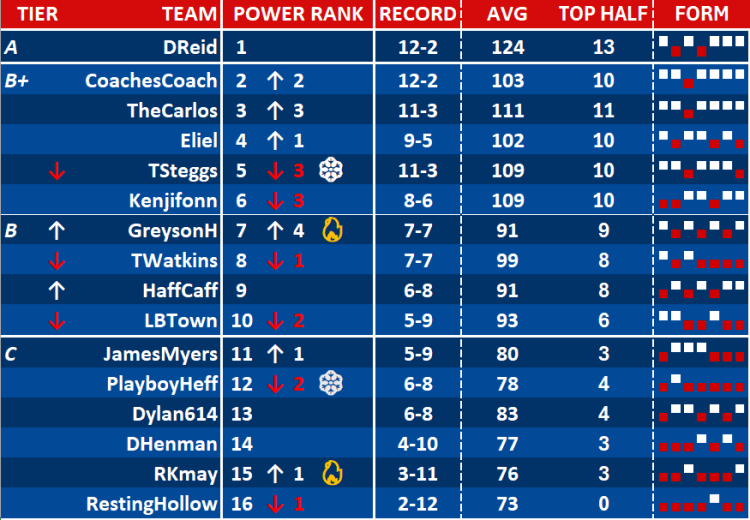
Since 2023, power rankings are based on a team’s power for the entire year.
Obviously power rankings are mostly based on a team’s personnel. But there are several other factors that are weighted when determining the rankings, such as: a manager’s ability to set lineups (historically), a manager’s ability to navigate the waiver wire (historically), and a team’s perceived luck.
Columns
- TIER: Power tier. Although teams are carefully ranked in order of perceived power, tiers act as a more concrete indicator of a team’s strength. Moving tier s requires significantly more evidence than simply moving up/down in the rankings. Teams within the same tier should be viewed as virtual equals.
- POWER RANK: Power Ranking. Movement compared to previous rankings. Emoji indicators.
- RECORD: A team’s Win-Loss record in 2025.
- AVG: A team’s average points-for rounded to the nearest whole number.
- TOP HALF: The number of times a team has scored enough points to place in the top eight in a week. This can also be considered the number of wins a team would have in a matchup-less vacuum.
- FORM: A team’s win/loss record in order from oldest to most recent game.
Emojis
Some teams have an emoji in their POWER RANK column. Emojis are a brief way to communicate major takeaways that may be affecting a team’s power ranking. Emojis are usually excluded if a condition is met but not actually affecting the team’s ranking.
- Fire: This team has been especially strong in recent games.
- Snowflake: This team has been especially weak in recent games.
 Nilbog Fantasy League