There are nine poll questions for the 2023 ballot. Any changes which pass will take effect at the start of the 2024 season. A simple majority of votes (9) is needed to pass any measure. Below you can find explainers for each proposal. Please be aware that just because the commissioner has polled these changes that is not an endorsement of any proposal.
Confirmation of 2022’s Changes
As promised in 2022, some of the changes which were passed in last year’s ballots got a one season trial run this year. On the 2023 ballot, you can vote to keep those changes.
#1 – Confirm Tight End Premium
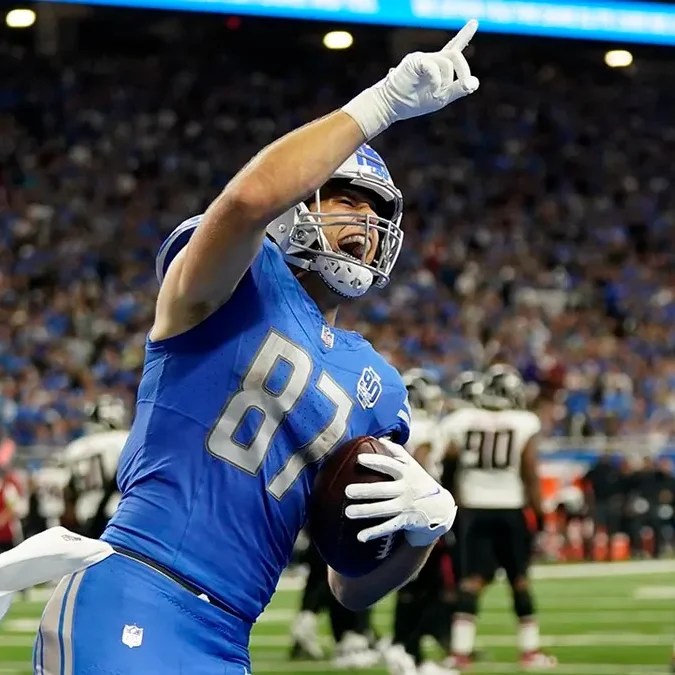
A 0.5 point-per-reception premium was added for tight ends this season. You may vote to keep that change indefinitely. Since introducing the TE premium, Nilbog has seen an increase in the amount of tight ends in flex spots as predicted.
Please see last year’s ballot article for information on tight end premium.
#2 – Confirm 8 Bench Slots

Last year the league very narrowly voted to remove one regular bench spot on rosters. This year you will have the opportunity to continue with 8 bench spots for another year or add one bench spot.
More bench spots increase the value of late picks and lottery ticket players. Less bench spots increase the value of FAAB and favor active management.
Please see last year’s ballot article for more information on roster sizes.
Changes to Scoring
#3 – Add QB Bonuses
Nilbog provides point bonuses for rushing and receiving, but does not provide bonuses for quarterbacks. It is unknown whether this was an oversight at the time of conception or intentional. Regardless, the following bonuses to quarterback play are being proposed for next year:
| 300 – 399 Yard Passing Game | 1 Point |
| 400+ Yard Passing Game | 2 Points |
You will have the opportunity to remove or modify this bonus in next year’s ballot if the proposal passes.
#4 – Six-Point Passing Touchdown
You aren’t drafting a quarterback versus a running back; you’re drafting for value at a position, and that means what you care about more than anything else is how a quarterback performs compared to his fellow quarterbacks, and every quarterback gets the benefit of the extra scoring. So leagues with six-point TDs don’t automatically take quarterbacks from “draft late” to “load up in the first round.” The changes are more subtle than that…
Pro Football Focus, 2019
Rushing quarterbacks are insanely appealing in normal fantasy leagues, but less so in six-point TD leagues, because they have that much more of a gap to make up [against elite passing QBs]…
For guys with normal ceilings, their draft stock, relative to other quarterbacks, doesn’t change much. For guys with elite ceilings in passing touchdowns draft stock can shoot up.
Passing touchdowns are currently worth the long-time fantasy football standard of four points. But since 2019 there has been a growing trend towards six-point passing touchdowns to increase parity between pocket passers and rushing QBs. This trend is more prominent in superflex leagues, but you could easily make the case Nilbog is a de-facto superflex league (without the actual superflex slot):
- In a regular 12 team dynasty league, at least 24/32 starting QBs will be rostered. That’s a starter and backup for each team.
- In a regular 12 team superflex league, all 32/32 starting QBs will be rostered. This is two starters for each team and an additional backup for eight teams.
- In Nilbog, all 32/32 starting QBs are rostered. This is a starter and backup for each team. Obviously Nilbog has more in common with superflex when it comes to quarterback valuation. (It is a QB league after all.)
Here’s an at-a-glance breakdown of scoring differences with six-point passing touchdowns.
| PPG Rank Group | Current Average PPG | PPG With 6pt/TD | Points Gained |
|---|---|---|---|
| 1-8 | 20.86 | 24.54 | 3.68 |
| 9-16 | 18.28 | 21.31 | 3.03 |
| 1-16 | 19.57 | 22.92 | 3.35 |
| 17-32 | 13.41 | 15.41 | 2.00 |
Currently a top 8 quarterback averages 14% more PPG than a quarterbacks ranked 9-16. With a 6 point passing touchdown, top 8 QBs average 15% more than the next 8.
On average, QBs gained 2.67 points per game from a six-point passing touchdown. Generally QBs that are already highly ranked gained about a point more per game than other QBs.
Pros:
- Increases parity between running QBs and passing QBs.
- Increases the value of good quarterbacks.
- Increases max potential points.
- Simplifies touchdown points across all positions.
- Further centralizes the quarterback in a way that mirrors their NFL value.
Cons:
- Increases the disparity between good and bad quarterbacks.
- Significantly centralizes the quarterback position, disadvantaging teams with weak QB play.
#5 – Combine Rushing/Receiving Bonuses
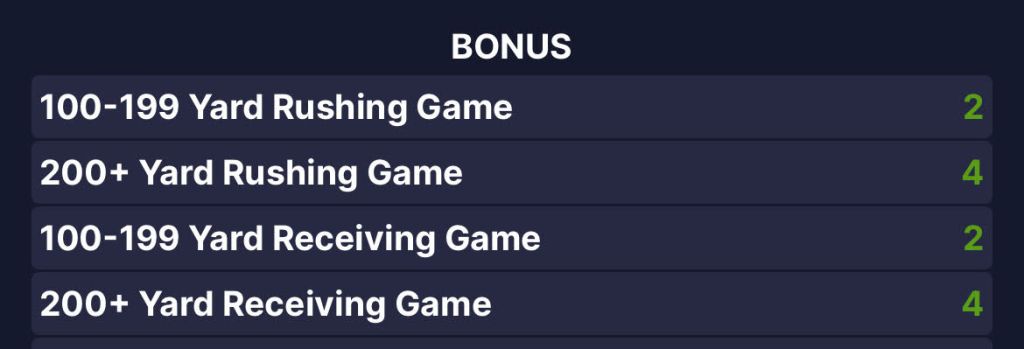
The bonuses for rushing and receiving are currently as follows:
Bonuses are intended to reward especially strong performances by a player, as well as provide additional excitement to owners beyond the average points for yards/touchdowns by setting milestones for extra ways to score.
As you can see, the bonuses for rushing and receiving are equal. But if a player gets 99 yards rushing and 99 yards receiving separately, they do not gain any bonus. This proposal would switch bonuses from the above to the below:
| 100 – 199 Combined Rush + Rec Yards | 2 Points |
| 200+ Combined Rush + Rec Yards | 4 Points |
It is important to note that this would disqualify a player from doubling up on the bonuses and receive six points. For example, a player will no longer be able to rush for 200 yards, receive for 100 yards, and gain a six point bonus since they would be combined for a four point bonus in the proposed change.
However, a player has never qualified for the combined six point bonus in Nilbog history anyway. And I could only find an instance of it happening once ever – in 1961.
The Case in Favor:
The purpose of scoring bonuses is to award strong yardage performances and increase parity with touchdown dependent players. Combining rushing/receiving bonuses mean pass-catching backs who rarely hit 100 yards in either category independently but frequently break 100 all-purpose yards will also be able to qualify for the bonus.
The Case Against
The purpose of scoring bonuses is to award players who excel in gaining yardage at their position. Combining the yardage allows low-volume third down backs and gadget players the same chance at a bonus as workhorse running backs. With PPR already providing a buff to receivers and playmaker RBs, this change would likely favor pass catchers who get occasional rushing opportunities even more.
Changes to League Mechanics
#6 – Eliminate Points-For As Tiebreaker
Nilbog’s tiebreakers for playoff seeding can be found on this page.
This proposal would eliminate regular season points-for as a tiebreaker completely. This would mean Nilbog matches the NFL’s tiebreaker order.
The Case in Favor
The entire purpose of having matchups is to play to win each week. Eliminating points-for and making the first tiebreaker head-to-head record means that division and conference matchups rightfully gain even more importance. Points-for can be significantly altered for better or worse with a couple outlier weeks, but having the better record is an indicator of a stronger, more consistent team.
The Case Against
The best indicator of a team’s success is the amount of points they scored in the regular season. By keeping points-for as a tiebreaker you ensure better teams make the playoffs. Additionally, points-for is the standard for almost every other fantasy league.
#7 – Switch to NFL Draft Order
For information on Nilbog’s draft order, please see the newest Draft Board here.
An NFL draft order would mean that the lower a team finishes the season the better their draft pick will be at an exact 1:1 rate.
Pros
- Guarantees bad teams get good picks instead of the current Plinko system.
- In the current system many middling teams have traded away picks, so they do not always directly benefit from winning the consolation bracket.
- Picks are easier to project.
- Mirrors the real NFL for a more NFL-sim experience.
- Is the standard in most dynasty leagues.
Cons
- Current system creates an exciting post-season bracket for teams that missed the playoffs.
- May incentivize tanking for teams that know they won’t make the playoffs.
- Bad teams still generally get good picks with the current system.
#8 – Add Taxi Poaching
Taxi poaching is meant to simulate practice squad poaching in the NFL. The mechanic has become popular over the last two years in dynasty formats. The proposed terms are as follows:
- Team One may offer (a) pick(s) in the next year’s draft in exchange for Player X on Team Two’s taxi squad.
- Team Two will have one week to either promote Player X to their active roster or accept the trade. They can not decline and keep the player in a taxi slot.
- Team One’s offer must be a pick that reaches the minimum required offer threshold from the table below. Offers below the threshold may still be sent as a regular trade but is not bound by the rules of taxi squad poaching. Team One can offer a higher pick if they do not have the minimum pick available. All picks must be for the next draft.
- If Team Two accepts the offer, Team One must use an active roster slot on Player X. The player can not go from a taxi slot to another taxi slot.
- If a player has been traded, their minimum required offer is based on their original draft capital. If a player is cut and re-signed by a different team, their minimum required offer is the same as an undrafted free agent.
- Offers must be made publicly in the Sleeper chat. Responses are due by the same day next week. Teams who do not respond by either promoting the player or accepting the trade will have the trade forced by the commissioner.
- If multiple teams make an offer for Player X, they may choose to outbid one another. In this instance, Team Two must select the bid with the highest draft capital if a trade for Player X is accepted. Teams may bid for up to one week from the original offer or until Team Two accepts a trade/promotes the player.
- If multiple teams offer the same bid, Team Two may choose which offer to take.
- Offers that include active players are not bound by the rules of taxi squad poaching. If Team One offers a draft pick for Player X and Team Three offers another player instead, Team Two may choose to accept Team Three’s offer.
| Draft Capital | Freshman Minimum Offer | Sophomore Minimum Offer |
|---|---|---|
| 1.01 – 1.08 | 2 1st Round Picks | 1st Round + 2nd Round Pick |
| 1.09 – 1.16 | 1st + 2nd Round Pick | 1st Round Pick |
| 2nd Round | 1st Round Pick | 2nd Round Pick |
| 3rd Round | 2nd Round Pick | 3rd Round Pick |
| Undrafted Free Agent | 3rd Round Pick + FAAB Spent | FAAB Spent + $25 |
Pros
- Increases parity by ensuring that players who could start on bad teams are not stashed on the taxi squads of good teams.
- Specifics can be modified over time to find a sweet spot.
Cons
- Makes it harder to stash deep sleepers, fliers, and lotto pick players long term.
- May force teams to make decisions they’d rather avoid.
# 9 – Change or Eliminate Weekly Cash Bonus
The $10 bonus for most points in a week is being eliminated in 2024. You can choose to completely eliminate weekly bonuses or replace it with a system that instead provides a $10 bonus for different achievements each week. Below is the weekly achievements:
| Week | Achievement Name | How to Win |
|---|---|---|
| 1 | Hot Start | Most Points |
| 2 | Nelson Agholor Special | WR With Most Points Through First 2 Weeks |
| 3 | Coach of the Year | Most Efficient Lineup |
| 4 | MVP | Highest Scoring Player in Lineup |
| 5 | Missed Connections | Highest Scoring Player on Bench |
| 6 | Lamar Miller Special | RB Closest to 11 Points Without Going Over |
| 7 | Halftime Bonus | Currently in 1st Leaguewide |
| 8 | Close Call | Lowest Points in Victory |
| 9 | Biggest Loser | Most Points in Loss |
| 10 | The Long Haul | Player With Longest Single Rush or Reception |
| 11 | Go Back to Your Conference | Widest Margin of Victory |
| 12 | Streaker | Longest Active Win Streak |
| 13 | Too Much Stuffing | Worst Performing Thanksgiving Day Player |
| 14 | Consolation Bracket Favorite | Most Cumulative Points-Against (Entire Season) |
Alternatively, you can vote to forgo weekly bonuses and reduce yearly buy-in from $30 to $20.
If this passes, we can also take suggestions for other achievements and bonuses in future years.
Repolls for 2024
If some proposals pass, they would be automatically repolled in 2024. Proposals that will not be automatically repolled may still be repolled regardless in 2024 or beyond at the commissioner’s discretion.
 Nilbog Fantasy League